Newton Thomas Sigel is the cinematographer for the film Bohemian Rhapsody. He is most known for his work with director Bryan Singer on the films X-Men, The Usual Suspects, Valkyrie, and again, Bohemian Rhapsody. He has been the primary cinematographer for a number of films, many of which earned him awards for outstanding cinematography. Sigel has worked on films of numerous genres, and focuses his work on the storytelling aspect of movies. Critics say Sigel has no actual style of cinematography because of his ability to adapt to many different genres of cinema. The film Bohemian Rhapsody is dominated by medium shots, although Singer does include various different camera angles and viewpoints. An equal emphasis on both the characters and their setting is created through these–predominantly medium–shots. Sigel and Singer create a world on screen that resembles the life of Freddie Mercury during his time in Queen. Due to their accuracy at creating this view on screen, the movie is clearly realistic.
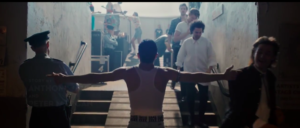
- Dominant: Our eye is first attracted to Freddie in the center of the frame, due to the fact that he is taking up a lot of space in the view with his arms spread open wide.
- Lighting/shading: The lighting in the image is unique because the main focus, Freddie is in the dark as he is coming out of the shadows onto the brightly lit stage at Live Aid. The contrast in lighting is powerful in this image as it captures the energy that radiates from a giant crowd for these performers.
- Proxemics: In this image Freddie Mercury is the main focus, as he gets excited to run on stage for unfortunately one of the last times. The audience can see his upper body from the waist up. Sigel likely chose this angle because he is lower than the stage, so it allows the audience to get a view of what goes on backstage before a concert while simultaneously viewing Freddie.
- Angle: The image is viewed from eye-level, as if you were standing behind Freddie following him up to the stage. Following this shot, the cameraman follows Freddie making it feel like viewers are right there running behind him.
- Color values: The colors in this shot are fairly dull. By keeping the colors dull Sigel is able to really emphasize the difference between light and dark. In the film, colors really emphasize what is happening in Freddie’s life. For example when the band is on tour of America and everything is going good for Freddie, the images on screen are vibrant and colorful, however when Freddie gets diagnosed with AIDS and his life falls apart, the dull colors reflect this struggle. At this final Live Aid concert–despite the tremendous accomplishment of performing at Live Aid–the fact that this could be Queens final performance together hangs heavy over Freddie and the band. Singer and Sigel portray this deeper emotion through the colors on screen.
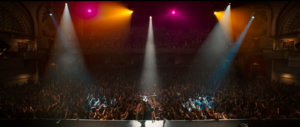
*Here, the bright colors used during the bands great success on their tour of America is shown.
- Subsidiary images: After taking in the dominant image of Freddie, the audience can get a glimpse of how many other people there are working behind the scenes of a concert. Examining this image can also emphasize the theme that even when surrounded by thousands of people and fans, a star can still feel alone just as Freddie did in this film.
- Density: This image is moderately packed with visual information. Freddie is in the center of the frame which establishes some simplicity to the view, although as the viewer’s eye moves around the image, they can absorb a lot of visual information which foreshadows the importance of Freddie’s character in the film to come.
- Composition: The two-dimensional space is organized by the contrast in lighting created. The center and top of the image are brightly lit, bringing the audience’s attention to here. Freddie is a darker image in the center of this, depicting him as the most important figure in this scene. The tunnel in front of him also serves to force viewers to look at Freddie.
- Depth: This image contains all three planes of view. The background is higher up than the foreground, allowing for a clear view of the midground in the image. It is an interesting view because one can really feel Freddie transition from the foreground to the background through this tunnel, leaving backstage behind him.
- Character placement: Characters occupy all three planes in this frame, and seem to be scattered across all parts of the framed space. Freddie however is clearly the main focus of the image as he is directly in the center of the view and all these people.
